
PPWR Timeline: Key Dates and Deadlines Explained

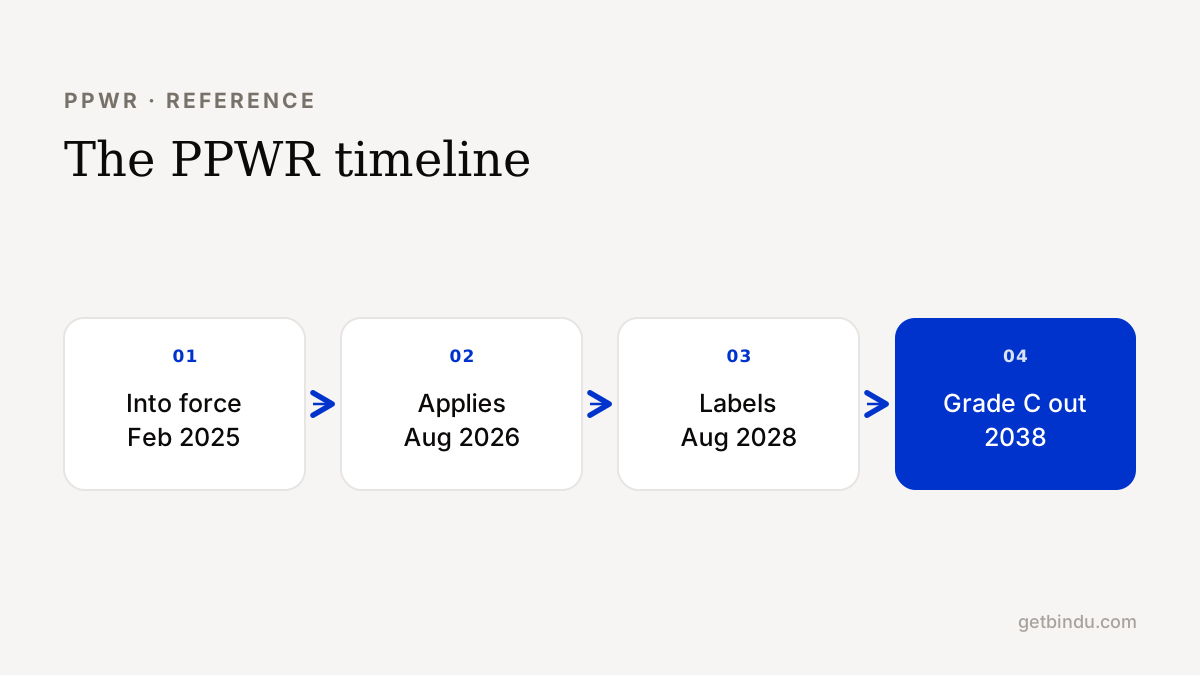
The PPWR is the EU Packaging and Packaging Waste Regulation, Regulation (EU) 2025/40. It entered into force on 11 February 2025 and starts to apply on 12 August 2026. From that date, most core obligations bind: substance limits, the declaration of conformity, technical documentation, and operator duties. Later requirements, such as harmonised labelling in 2028 and recyclability grades from 2030, follow on their own dates.
At a glance:
- The PPWR is Regulation (EU) 2025/40, in force since 11 February 2025.
- It applies from 12 August 2026, when most core obligations bind.
- Harmonised labelling follows from 12 August 2028.
- Reuse and refill targets start phasing in from 1 January 2030.
- Grade C packaging leaves the EU market on 1 January 2038, not 2035.
The PPWR does not switch on all at once, and several of the dates circulating online are wrong.
Why the PPWR has a staggered timeline
A filing rule usually has one start date. The PPWR does not. It is a stack of separate obligations. Each one turns on when the machinery behind it is ready.
Entry into force is the day the regulation became law, 11 February 2025. The obligations did not bind yet. The date only anchors the counting periods written into the text. The date of application is 12 August 2026, when the core duties start to bind.
Some duties, like the substance limits, apply straight away in 2026. Others depend on technical criteria the Commission still has to publish. It publishes those through delegated or implementing acts. So those obligations carry a date that reads as one of two things, whichever falls later: a fixed calendar date, or a set period after the criteria appear.
That is why an honest PPWR timeline gives a firm date for some items. For others, it gives a careful "at the earliest".
The PPWR timeline, date by date
| Date | What happens | How firm it is |
|---|---|---|
| 11 February 2025 | PPWR enters into force | Law, but not yet applied |
| 12 August 2026 | PPWR applies; core obligations bind | Firm |
| 12 August 2028 | Harmonised labelling starts | Firm, or 24 months after the implementing acts, whichever is later |
| 1 January 2030 | Reuse and refill targets phase in | Firm |
| 2030 at the earliest | Recyclability grades, recycled content, empty-space ratio | Depends on Commission criteria |
| 2035 | Recycled-at-scale factor added to the recyclability grade | Firm |
| 1 January 2038 | Grade C packaging off the EU market | Firm |
The regulation became law on 11 February 2025, which is the date several counting periods inside the text run from.
The same date closes the old regime. Directive 94/62/EC, the 1994 packaging directive the PPWR replaces, is repealed with effect from 12 August 2026. A few of its articles keep applying past that day, each one tied to a Commission act that has not appeared yet.
The one that matters most is 12 August 2026. The Article 5 substance limits take effect that day, including the PFAS restriction on food-contact packaging. So do the conformity assessment, the technical documentation, the declaration of conformity, operator identification, importer and distributor duties, traceability, and national registration as a precondition to selling.
Harmonised labelling follows on 12 August 2028. It covers material composition and recycled content. The date can slip to 24 months after the implementing acts behind it, whichever falls later. Sector reuse and refill targets begin to phase in on 1 January 2030.
Three items carry 2030 only as a floor: the recyclability grades, the minimum recycled content in plastic parts, and the empty-space ratio. Each starts on the later of two dates. One is fixed. The other runs from Commission criteria that were not yet adopted. So these three arrive only once those criteria are published. Last comes 1 January 2038, when grade C packaging can no longer be placed on the EU market. Grades A and B remain.
The date that gets quoted wrong
You will see 2035 quoted as the year grade C packaging is banned. That is not what the text says.
The 2035 date is when the recycled-at-scale factor is added into the recyclability grade. The point at which grade C can no longer be placed on the market is 1 January 2038. Two different events. Two different years. They get merged into one wrong sentence.
Grade C packaging is packaging in the lowest recyclability grade, the grade removed from the EU market in 2038. If a PPWR page you are reading carries the 2035 ban, treat the rest of its dates with the same caution.
A worked example: one packaging line through the timeline
Take a company that sells a food product in a plastic tray into the EU market.
- By 12 August 2026, the tray has to meet the Article 5 substance limits, including the PFAS restriction on food-contact packaging. The company needs a declaration of conformity, technical documentation, and national registration in place. Nothing is filed on that day. The file simply has to exist if an authority asks.
- From 12 August 2028, the tray carries the harmonised material-composition label, and the recycled-content label where that applies.
- From 1 January 2030, if the tray falls under a sector reuse target, the reuse and refill obligations start to phase in.
- Once the Commission publishes the recyclability criteria, the tray gets a recyclability grade. It also has to meet the minimum recycled content in its plastic parts.
- By 1 January 2038, if the tray still grades C, it can no longer be placed on the EU market.
One product, six moments. That is why a single "PPWR deadline" is misleading.
What to do before 12 August 2026
The one date to plan around is 12 August 2026. On that day the documentation has to already exist. Nothing is submitted to anyone. An inspector simply asks to see it.
Before then, the practical work is short to list and long to do. Know which of your packaging types are in scope. Assess each one against the substance and design rules that apply in 2026. Draw up the declaration of conformity for each. If an enforcement authority asks, you have a short window to produce that documentation.
For what the PPWR requires and who carries the duty, start with what the PPWR is. It sits alongside CBAM and the deforestation rules as another strand of trade compliance attached to goods you already ship.
Where Bindu fits. Bindu reads the PPWR dates out of Regulation (EU) 2025/40 itself, including the ones that only start counting once an implementing act is adopted. See the PPWR breakdown.
FAQ
When does the PPWR come into effect? The PPWR entered into force on 11 February 2025 and starts to apply on 12 August 2026. Most core obligations, including substance limits and the declaration of conformity, bind from 12 August 2026.
Source: EUR-Lex: PPWR, Regulation (EU) 2025/40
What is the significance of 12 August 2026? It is the date the PPWR applies. From that day, the substance restrictions, conformity assessment, technical documentation, declaration of conformity, operator identification, and traceability duties all take effect. The supporting documentation has to exist by then.
Source: EUR-Lex: PPWR, Regulation (EU) 2025/40
When do PPWR labelling rules start? The harmonised material-composition and recycled-content labelling rules apply from 12 August 2028, or 24 months after the relevant implementing acts, whichever is later.
Source: EUR-Lex: PPWR, Regulation (EU) 2025/40
Is grade C packaging banned from 2035? No. Grade C packaging can no longer be placed on the EU market from 1 January 2038. The 2035 date refers to when the recycled-at-scale factor is added to the recyclability grade, which is a separate change often confused with the ban.
Source: EUR-Lex: PPWR, Regulation (EU) 2025/40
Has the PPWR been delayed? The core application date remains 12 August 2026. Some later obligations, such as recyclability grades and recycled-content minimums, depend on Commission criteria not yet published, so they effectively begin only once those acts are adopted. The Commission tracks which of those acts have landed on its packaging waste page.