
What is an HS Code? Structure, Examples, and Use

Every product that crosses a border has a number. That number decides more than most people shipping the product realise.
It sets the duty rate. It decides whether a licence is needed. It now decides whether a product falls under a new regulation or stays outside it.
Put the wrong number on the line and you can overpay duty for years. Or underpay it and owe the difference, with a penalty on top.
That number is the HS code.
At a glance:
- An HS code is the number that classifies a product for customs, run by the World Customs Organization.
- The first six digits are the same in every country that uses the system.
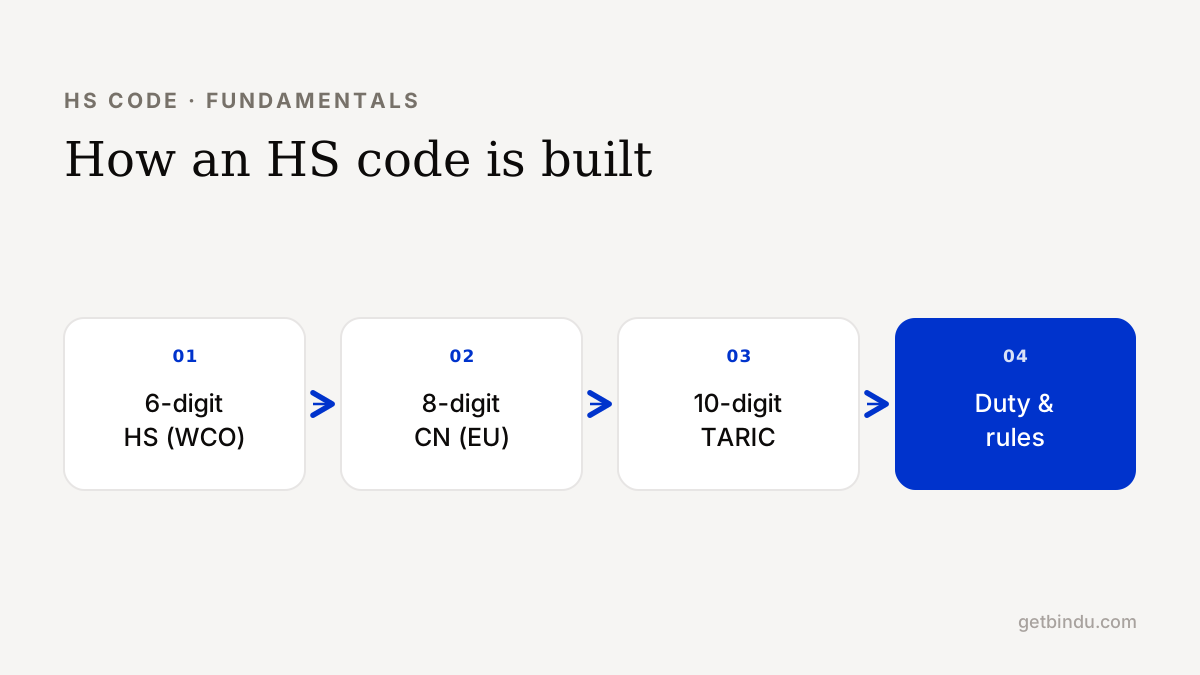
- The EU extends the code to eight digits (Combined Nomenclature) and ten digits (TARIC).
- The code sets the duty rate and decides which rules, licences, and regulations apply.
- Get it wrong and you can overpay duty, owe the difference with a penalty, or misjudge whether a rule like CBAM or EUDR applies.
What is an HS code?
The Harmonized System is a global system for naming and numbering traded products, run by the World Customs Organization. HS is its everyday short name.
More than 200 countries use it. That is the whole point. An HS code means the same thing in Rotterdam, Shanghai, and New York.
An HS code is the number given to a product under that system.
The first six digits are the base, and those six are identical worldwide. Anything beyond six digits is added by a country or bloc for its own tariff and statistics.
That is why the same product can have a longer code in the EU than the bare six-digit number.
An HS code is the customs identity of a product. It tells every border what the thing is and how to treat it.
How the code is built
An HS code is read left to right. Each pair of digits narrows the product down.
Take roasted coffee, HS 0901 21:
- 09 is the chapter: coffee, tea, maté, and spices.
- 0901 is the heading: coffee, whether or not roasted or decaffeinated.
- 0901 21 is the subheading: coffee, roasted, not decaffeinated.
Those six digits are the same in every country that uses the system.
From there, jurisdictions extend the code. Each layer keeps the six-digit base and adds a tail for local use.
- In the EU, two more digits form the Combined Nomenclature (CN), an eight-digit code used for the EU tariff and trade statistics. This is the code an EU importer usually needs.
- The EU then adds two more for TARIC, a ten-digit code that layers on anti-dumping duties, suspensions, and quotas.
- Other countries have their own tails. The United States uses a ten-digit HTS code on the same six-digit base.
So the same coffee is 0901 21 to the world, and 0901 21 00 in the EU's Combined Nomenclature. The first six digits never change. The tail depends on where you file.
The table below shows how the layers stack up.
| Code | Digits | Set by | What it is used for |
|---|---|---|---|
| HS | 6 | World Customs Organization | Global product identity, the same in every country |
| Combined Nomenclature (CN) | 8 | European Union | The EU tariff and trade statistics |
| TARIC | 10 | European Union | Anti-dumping duties, suspensions, and quotas |
| HTS | 10 | United States | The US tariff schedule |
The Combined Nomenclature is the EU's eight-digit extension of the HS code, used for the EU tariff and trade statistics. TARIC is the EU's ten-digit code that layers anti-dumping duties, suspensions, and quotas on top of it.
Why the code matters so much
Duty runs off the code. It sets the tariff, and a few digits' difference can move a product between a zero rate and a double-digit one. So a single misplaced digit is a price, paid on every shipment.
The bill is rarely one shipment. A wrong code repeated across many entries becomes a back-duty assessment, with a penalty on top.
Import bans, quotas, anti-dumping duties, and licences attach to codes too, not to product names. Regulatory scope is drawn the same way. Whether goods fall under CBAM or the EU Deforestation Regulation is defined by code ranges. On an EUDR due diligence statement the CN code is a required field.
Preferential tariffs under trade agreements are granted by code as well. The wrong one can cost you a rate you were entitled to.
| What attaches to the code | What it decides |
|---|---|
| Duty rate | The tariff owed at import |
| Import controls | Bans, quotas, anti-dumping duties, and licences |
| Regulatory scope | Whether CBAM or EUDR applies, drawn by code ranges |
| Preferential tariffs | Lower rates under trade agreements, granted by code |
Get the code right and the rest of trade compliance has a foundation. Get it wrong and every later step inherits the error.
Where classification goes wrong
Classification looks like a lookup. It behaves like a judgement.
The common failures are familiar to anyone who has done it at volume.
- Classifying by what a thing is called, not what it is. Marketing names and customs categories rarely match. The code follows material, function, and how the product shows up at the border.
- Stopping at six digits when the country needs eight or ten. An EU declaration needs the full CN code, not the bare subheading. For example, roasted coffee is filed as 0901 21 00 in the EU, not the six-digit 0901 21.
- Ignoring the General Rules of Interpretation. Sets, mixtures, parts, and unfinished goods have specific rules. Guessing usually loses.
- Never checking binding rulings. Customs authorities publish binding decisions. A ruling on a product like yours is the strongest evidence you can cite, and most importers never look.
When the code is genuinely uncertain, the safe route is a Binding Tariff Information decision in the EU, or its equivalent elsewhere. Binding Tariff Information is a written classification decision from an EU customs authority that you can rely on.
Where Bindu fits. The code decides everything downstream, so it is the worst place to guess. Bindu reads each invoice line into a product, proposes an HS code with the reasoning and any binding rulings beside it, and carries the confirmed code into every filing that depends on it. See how it works.
FAQ
What is an HS code used for? An HS code classifies a product for customs so authorities worldwide identify it the same way. It sets the duty rate, decides which rules and licences apply, and now decides whether a shipment falls under regulations like CBAM and EUDR.
Source: World Customs Organization: What is the Harmonized System
How many digits is an HS code? The core Harmonized System code is six digits and is the same in every country. The EU extends it to eight digits (Combined Nomenclature) and ten (TARIC). The United States uses a ten-digit HTS code. The first six digits are always identical.
Source: European Commission: EU Customs Tariff (TARIC)
What is the difference between an HS code and a CN code? The HS code is the six-digit global code from the World Customs Organization. The CN code is the EU's eight-digit extension of it, used for the EU tariff and trade statistics. An EU importer usually needs the full CN code.
Source: European Commission: Combined Nomenclature
How do I find the right HS code for my product? Start from what the product is made of and does. Work down chapter to heading to subheading, apply the General Rules of Interpretation for sets and parts, and check published binding rulings. Where it is uncertain, request a Binding Tariff Information decision.
Source: World Customs Organization: What is the Harmonized System
What happens if I use the wrong HS code? The wrong code can mean overpaying duty, or underpaying and owing the difference with a penalty. It can also mean missing a licence, or wrongly treating goods as in or out of scope for a regulation. Because so much attaches to the code, an error flows into every later step.
Source: World Customs Organization: What is the Harmonized System