
What is an SVHC? The REACH Candidate List Explained

The purchase order has one extra line this year. "Confirm no SVHCs above 0.1%."
Your buyer will not release payment without it. The parts came from a dozen suppliers, and the phrase is new to half of them.
Three letters, one threshold, and a list that changes twice a year. That is what sits behind that line.
It unpacks into a definition and a single percentage, and both are easy to get wrong.
At a glance:
- An SVHC is a substance of very high concern under REACH, listed by ECHA on the Candidate List.
- A substance qualifies under Article 57: CMR, PBT or vPvB, or equivalent concern such as endocrine disruptors.
- The Candidate List holds more than 250 substances and is updated about twice a year.
- The 0.1% by weight threshold is tested per article, not per finished product, as Case C-106/14 confirmed.
- Above 0.1%, three duties follow: tell business customers, answer consumers within 45 days, and notify ECHA's SCIP database.
What is an SVHC?
An SVHC is a substance of very high concern under REACH. It is a chemical serious enough to deserve special tracking through the supply chain.
A substance becomes an SVHC when it meets one of the criteria in Article 57 of REACH. The main ones are:
- CMR: carcinogenic, mutagenic, or toxic to reproduction.
- PBT or vPvB: persistent, bioaccumulative and toxic, or very persistent and very bioaccumulative.
- Equivalent concern: cases such as endocrine disruptors, judged on the same level of seriousness.
Each route points at long-term harm. A CMR substance can cause cancer, damage genes, or harm reproduction. A PBT or vPvB substance does not break down, builds up in living tissue, and travels through the food chain. The equivalent-concern route catches hazards that are just as serious but do not fit the first two boxes.
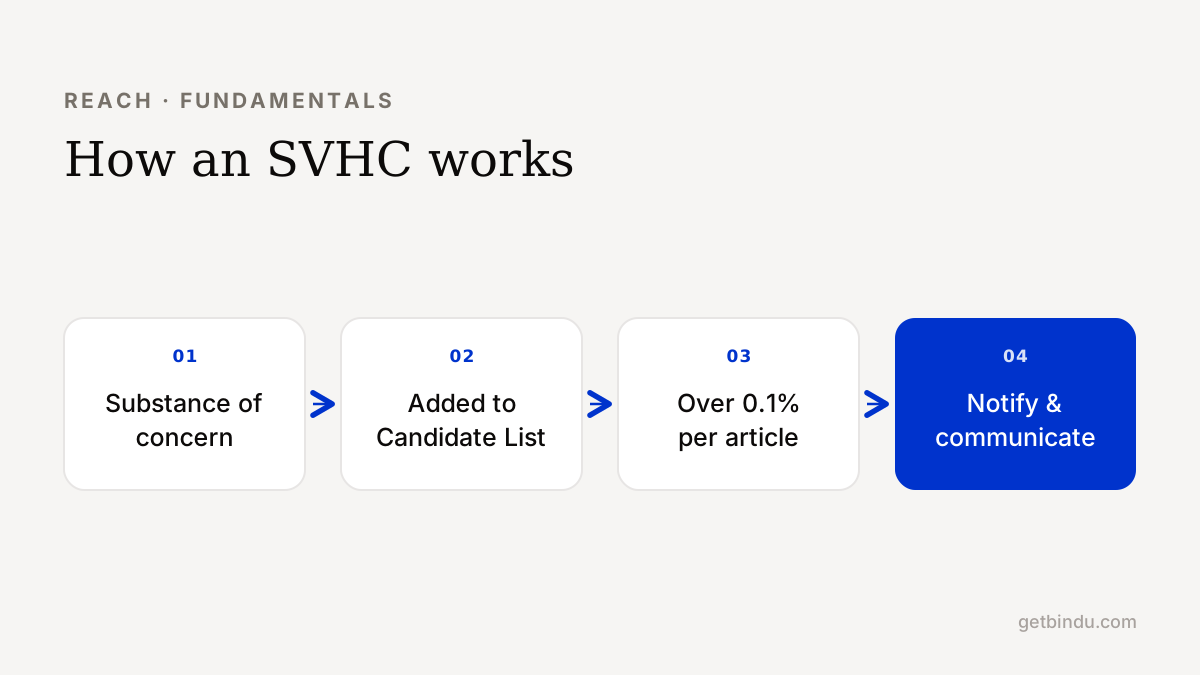
If a substance clears that bar, ECHA can add it to the Candidate List. That is the moment duties begin.
What is the Candidate List?
The Candidate List is the official register of SVHCs. It is the list your buyer means when they ask about SVHCs.
It holds more than 250 substances today, and it grows. ECHA updates it about twice a year, usually in winter and summer. For the current count and how to check one substance, see the SVHC list.
The name is a clue to what comes next. These are candidates for authorisation, the phase-out track under REACH. Some later move to Annex XIV, the Authorisation List, and need permission to use at all.
So the list is not static. A part that was clean last year can carry a listed substance this year, without anything about the part changing. Nothing in the part moved. The list moved under it.
The 0.1% rule
The 0.1% rule is the threshold that decides whether an SVHC on the Candidate List triggers any duty at all.
If an article contains an SVHC above 0.1% by weight, duties switch on. Below that, they do not.
The test is per article, not per whole product, as the EU Court of Justice confirmed in Case C-106/14.
A cable, a zip, a coated screw: each counts as its own article. A tiny component over 0.1% triggers the duty even if the substance is a rounding error across the finished product.
Take a winter jacket. The outer fabric tests clean. The zip carries a surface coating, and say that coating is 0.15% of the zip by weight. Measured against the whole jacket, that share is far below 0.1%. Measured against the zip, the article that actually holds it, it is over the line. The zip is the article, so the duty applies. The finished-product average never enters the sum.
What duties does an SVHC trigger?
Once an article is over the 0.1% line, three duties follow. None of them is a certificate. They are ongoing duties, tied to a list that keeps moving.
| Duty | Who you tell | What you provide | When |
|---|---|---|---|
| Communicate down the chain | Business customers | Enough to use the article safely, at minimum the name of the substance | With supply |
| Answer consumers | Any consumer who asks | Whether the article holds an SVHC over 0.1% | Within 45 days, free of charge |
| Notify SCIP | ECHA | A SCIP notification for the article | For Candidate List substances above 0.1% |
The first two duties both sit in Article 33 of REACH. You inform business customers, and you answer consumer questions on request within 45 days, free of charge. The third duty is separate. You notify ECHA's SCIP database for Candidate List substances above 0.1%, so the data follows the article on.
SVHC, restriction, and the passport
An SVHC on the Candidate List is about disclosure. It does not, by itself, ban the substance.
A restriction is a different mechanism: a hard limit or ban under REACH Annex XVII. A substance can sit on the Candidate List, face an Annex XVII restriction, or both at once.
Three mechanisms sit next to each other under REACH, and they are easy to blur.
| Mechanism | What it is | What it does |
|---|---|---|
| Candidate List | Register of SVHCs | Triggers disclosure duties above 0.1% |
| Authorisation List (Annex XIV) | The phase-out track | Use needs specific permission |
| Restriction (Annex XVII) | A hard limit or ban | Bars use outside set conditions |
Substance data is also becoming a published field. As the Digital Product Passport rolls out, starting with textiles, substances of concern are among the data a passport is expected to carry. That pushes SVHC tracking from a yearly scramble into a standing record.
Where Bindu fits. SVHC work is a list that changes twice a year and a threshold that bites per part. Bindu resolves each part to its substances by EC and CAS number, screens it against the Candidate List version of that day, and re-runs past screenings when the list updates. See the REACH breakdown.
FAQ
What does SVHC stand for? SVHC stands for substance of very high concern. It is a REACH classification for chemicals that are carcinogenic, mutagenic or toxic to reproduction, persistent and bioaccumulative, or of equivalent concern such as endocrine disruptors.
Source: EUR-Lex: REACH Article 57, substances to be included in the Candidate List
What is the REACH Candidate List? The Candidate List is ECHA's official list of substances of very high concern. It holds more than 250 substances and is usually updated twice a year. Substances on it can later move to the authorisation list.
Source: ECHA: Candidate List of substances of very high concern
What is the 0.1% rule for SVHCs? If an article contains a Candidate List substance above 0.1% by weight, the importer or producer has duties to communicate and to notify SCIP. The threshold applies per article, so a small component over 0.1% can trigger it on its own.
Source: Court of Justice of the EU: Case C-106/14 (the 0.1%-per-article ruling)
Do I have to answer consumer questions about SVHCs? Yes. Under REACH, a consumer can ask whether an article contains a Candidate List substance above 0.1%. You must respond within 45 days, free of charge.
Source: EUR-Lex: REACH Article 33, duty to communicate on substances in articles
What is the SCIP database? SCIP is ECHA's database of Substances of Concern In articles as such or in complex objects. Producers and importers of articles must notify SCIP when an article contains a Candidate List substance above 0.1% by weight.
Source: ECHA: SCIP database