
What is EUDR? The EU Deforestation Regulation, Explained

A procurement manager forwards you an email from an EU customer. From next year, it says, they can only buy this if it is EUDR compliant. Attached is a spreadsheet asking for the country of production, the plot coordinates, and a due diligence reference number. None of those live in your paperwork. You have a phytosanitary certificate, an invoice, and years of clean shipments, and suddenly that is not enough.
So the question lands first as five letters. What is EUDR, and why does it now decide whether you keep the account?
At a glance:
- EUDR is Regulation (EU) 2023/1115, the EU Deforestation Regulation.
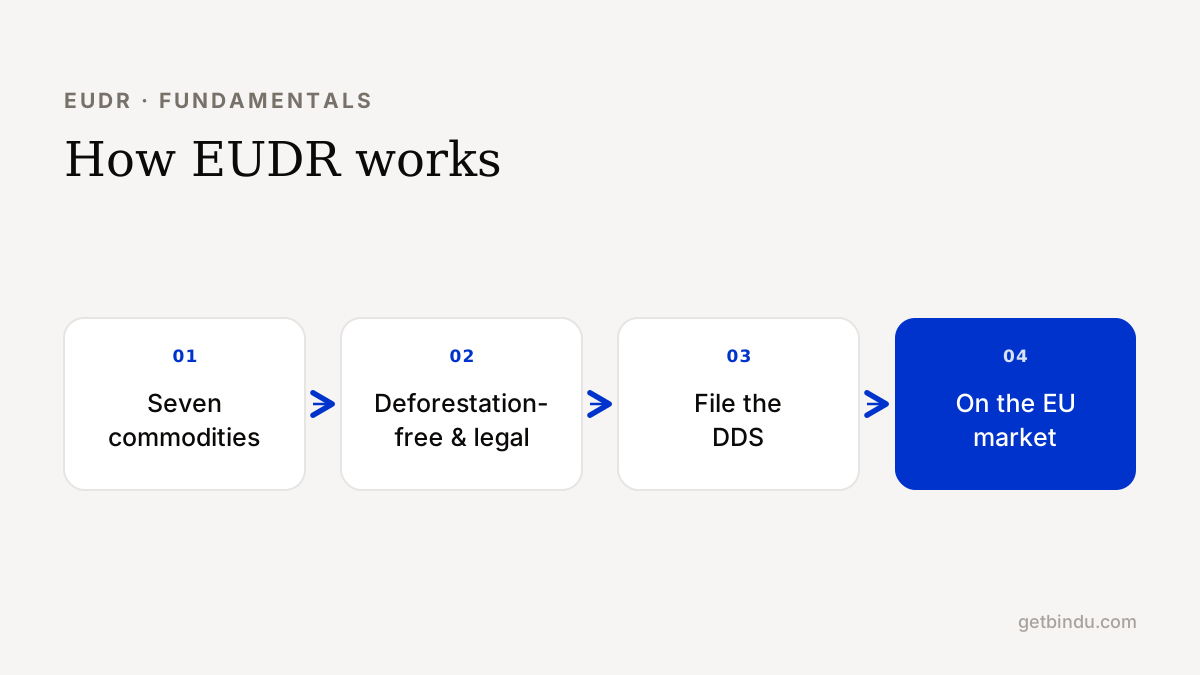
- It covers seven commodities: cattle, cocoa, coffee, oil palm, rubber, soya, and wood, plus products made from them.
- Goods must be deforestation-free after 31 December 2020 and produced legally.
- Operators file a Due Diligence Statement, or DDS, before the goods reach the EU market.
- It applies from 30 December 2026 for large and medium firms, and 30 June 2027 for micro and small ones.
What is EUDR?
EUDR is the EU Deforestation Regulation, formally Regulation (EU) 2023/1115. It entered into force on 29 June 2023. Once its own due-diligence duties start to apply, it repeals and replaces the earlier EU Timber Regulation. That older law is still the operative rule today, while the EUDR's obligations remain postponed.
Its rule is short. Certain goods may only be placed on the EU market, or exported from it, if the company can show two things. The goods must be deforestation-free. And they must have been produced legally in their country of origin.
It replaces trust with proof. The burden sits with the business bringing goods to market. The proof has to travel with the product.
The problem the EUDR targets
The EU is a significant consumer of commodities linked to forest loss, and that is the premise the regulation is built on. When European buyers import beef, chocolate, or furniture, some of that demand pulls on land that was recently forest.
That is imported deforestation. The trees fall somewhere else. The demand starts here.
The EUDR's logic is to close the EU market to goods that carry that cost, so European consumption stops paying for forest clearance abroad. The regulation does not ban the commodities. It bans the deforestation attached to them.
Which commodities does the EUDR cover?
The EUDR commodities are seven, and the list is fixed in the regulation:
- Cattle
- Cocoa
- Coffee
- Oil palm
- Rubber
- Soya
- Wood
Scope does not stop at the raw commodity. It reaches the products derived from each one, listed by HS code in Annex I. So the net catches many finished goods too. Examples include leather and beef, chocolate, and palm oil derivatives. It reaches tyres and other rubber goods, soya cake and animal feed, and wood products from furniture to paper and printed board.
A few things sit inside the net that people do not expect. Leather is cattle. Chocolate is cocoa. A wooden chair and a ream of paper are both wood. One narrowing is worth knowing: the December 2025 amendment removed certain printed products under HS heading ex 49, such as books and newspapers.
Coverage is defined by code, not by product name. So whether an item is caught comes down to its exact HS heading, not its label on an invoice.
Who does the EUDR apply to?
The regulation speaks in two roles.
- Operators are the businesses that place a covered product on the EU market for the first time, or export it from the EU. The EU importer is the classic operator. The operator carries the real duty. It must run due diligence and file the statement before the goods move.
- Traders are the businesses that make the product available further down the chain, once it is already on the market. Large traders carry duties close to an operator's. An SME trader's duty is narrower. Under Article 5(3) it holds its suppliers' and buyers' details, plus the reference numbers of the statements attached to the goods. It runs no due diligence of its own.
So the EUDR reaches you if you grow, trade, import, or manufacture any of the seven commodities into a product that lands on an EU shelf. Where you sit in the chain decides how much of the paperwork is yours.
The 2025 amendment lightened the load for two groups: downstream operators and traders, and a new category of small and micro primary operators in low-risk countries. Both get a simplified declaration and less repeated due diligence where the goods were already checked upstream.
The fine detail of that lighter regime, including which countries count as low-risk, is still rolling out through Commission guidance and delegated acts during 2026. Treat the direction as settled and the fine print as pending.
What the EUDR requires
At a high level, the EUDR asks for due diligence that ends in a Due Diligence Statement, or DDS. The operator files the DDS in the EU information system before the goods are placed on the market. That statement rests on three pieces of work.
| Requirement | What you must show | Where it comes from |
|---|---|---|
| Plot geolocation | Coordinates for every plot where the commodity was produced, to at least six decimal places. A point for plots up to four hectares, a polygon above that. | Article 9 |
| Deforestation-free | The land was not subject to deforestation after 31 December 2020. | 31 December 2020 cut-off |
| Legal production | The commodity was produced under the laws of the country of origin. | Legality test |
Two of those tests catch people out.
The deforestation-free cut-off is hard. It does not matter whether local clearing was legal. And the clock does not reset when the land changes hands.
The legality test is broad. It covers land-use rights, environmental protection, forest rules, third-party rights, labour, human rights, and tax and trade.
Pass both tests, assemble the evidence, and the operator files the DDS. Filing returns a reference number used at customs. For a closer look at that filing, read what an EUDR DDS is. For the practical build of a compliance programme, see EUDR compliance.
How due diligence actually works
Due diligence under the EUDR is three steps, not one check, and Article 8 names them.
First, information. Article 9 lists what you collect: the commodity, the quantity, the country of production, and the geolocation of every plot it came from. Coordinates run to at least six decimal places, and a plot over four hectares needs a polygon rather than a point. For cattle, geolocation covers every premises where the animals were kept.
Second, risk assessment. Article 10 sets the criteria you have to work through, and they apply per product and per source. A product drawing on many plots gets many assessments.
Third, risk mitigation. Article 11 requires mitigation measures unless the assessment finds the risk of non-compliance is negligible. That word is defined in Article 2(26), and it is a high bar. If the risk stays above it, the goods cannot be placed on the market at all.
Article 12 adds the part firms miss. Those three steps have to sit inside a documented due diligence system that you keep current, not a fresh scramble per shipment.
Reusing a statement from upstream
One provision saves real work on processed goods. A composite product, say furniture built from other wood products, can point at due diligence statements already filed upstream. You enter the earlier statement's reference number in the information system under Article 33, and the geolocation data behind it does not have to be supplied again.
That only holds if you have checked the upstream due diligence was properly done. The reference is a shortcut through the paperwork, never a transfer of responsibility. How that number works is covered in the EUDR DDS reference number guide.
The dates that actually apply
The EUDR was postponed twice. So most dates circulating online are wrong. Ignore the original 2024 and 2025 dates.
The current dates are set by Regulation (EU) 2025/2650. It was published in the Official Journal on 23 December 2025 and came into force on 26 December 2025.
- 30 December 2026 is the application date for large and medium, non-SME, operators and traders. This is the deadline that matters for most businesses.
- 30 June 2027 is the application date for micro and small enterprises and natural persons.
Until those dates, the prohibition, the due diligence duty, and the filing obligation do not bite. The Commission delivered a simplification review report on 4 May 2026, with a guidance package alongside it. That did not move these dates. They stand.
For the full history of adoption, entry into force, and the two delays, see the EUDR timeline.
How the EUDR fits alongside other EU rules
The EUDR is one of several EU rules that now travel with a product rather than sitting behind a border. Its cousin on climate is CBAM, which prices the carbon embedded in imported steel, aluminium and cement. The Digital Product Passport does something similar for batteries, and later for other goods.
The pattern repeats. The obligation is evidence, attached to the goods, provable on demand. An importer spanning several commodities can sit inside more than one of these at once, each with its own data to collect.
If your commodity is coffee specifically, we have a dedicated walkthrough: what EUDR means for coffee.
Where Bindu fits. Bindu reads the invoices and supplier records you already hold into products and origins, classifies each line, and opens the EUDR template pre-filled. You map each plot and run satellite checks against the 31 December 2020 cut-off. The Due Diligence Statement assembles from those plots and checks. The legal call stays yours. See how it works.

FAQ
What does EUDR stand for? EUDR stands for the EU Deforestation Regulation, formally Regulation (EU) 2023/1115. It restricts placing certain forest-linked goods on the EU market unless a company can prove they are deforestation-free and legally produced.
Source: EUR-Lex: EUDR, Regulation (EU) 2023/1115 (consolidated)
What commodities does the EUDR cover? Seven: cattle, cocoa, coffee, oil palm, rubber, soya, and wood, plus products derived from them such as leather, chocolate, tyres, furniture, and paper. Coverage is set by HS code in Annex I, not by product name.
Source: European Commission: EU Deforestation Regulation
Who does the EUDR apply to? Operators, the companies first placing a covered product on the EU market or exporting it, and traders who make it available further down the chain. The operator, usually the EU importer, carries the core due diligence and filing obligation.
Source: EUR-Lex: EUDR, Regulation (EU) 2023/1115 (consolidated)
What is the EUDR cut-off date? 31 December 2020. Goods must come from land that was not subject to deforestation after that date. The cut-off is fixed and does not reset when land changes ownership.
Source: EUR-Lex: EUDR, Regulation (EU) 2023/1115 (consolidated)
What does EUDR due diligence involve? Three steps under Article 8. Collect the information in Article 9, including plot geolocation. Assess risk against the Article 10 criteria. Apply mitigation under Article 11 unless the risk is negligible. Article 12 requires all of it to run inside a documented due diligence system.
Source: EUR-Lex: EUDR, Regulation (EU) 2023/1115 (consolidated)
When does the EUDR apply? 30 December 2026 for large and medium operators and traders, and 30 June 2027 for micro and small enterprises and natural persons, after two postponements. Earlier 2024 and 2025 dates no longer apply. See the full EUDR timeline.
Source: EUR-Lex: Regulation (EU) 2025/2650 (second postponement)