
What Is EUDR, and How Does It Affect Coffee?

A green-coffee buyer has sold to the same European roaster for years, from farms she has visited. This season the roaster wants EUDR documentation before the next contract, and she has never heard the word.
At a glance:
- EUDR is Regulation (EU) 2023/1115, the EU Deforestation Regulation.
- Coffee is one of seven commodities in scope, listed under CN heading 0901.
- Every coffee lot must pass two tests: deforestation-free after 31 December 2020, and legal production.
- The operator, usually the EU importer, files the Due Diligence Statement in TRACES.
- The deadline is 30 December 2026 for large and medium operators, and 30 June 2027 for micro and small operators.
What is EUDR, in one paragraph
EUDR is the EU Deforestation Regulation, formally Regulation (EU) 2023/1115, which entered into force on 29 June 2023. In short, it says certain goods can only be placed on or exported from the EU market if the company can prove two things. First, that the goods are deforestation-free. Second, that they were produced legally in the country of origin. Deforestation-free means the goods come from land that was not cleared of forest after the cutoff date. Proving both is the job of the business bringing the coffee into the EU, and the evidence has to travel with the shipment.
Why coffee is in scope
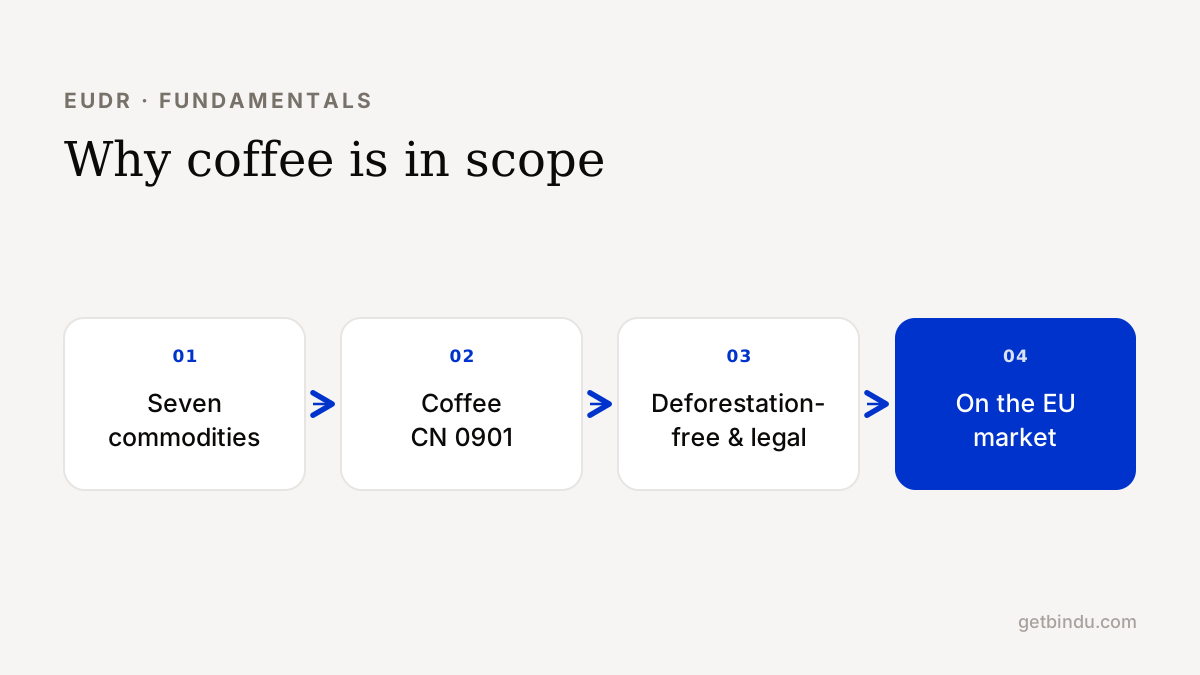
Coffee is one of seven commodities the regulation covers, alongside cattle, cocoa, oil palm, rubber, soya and wood, plus products derived from them. For the rule itself, across every commodity, read what EUDR is. Coffee sits under CN heading 0901, so green beans, roasted beans and most coffee products fall inside the net. If your business grows, trades, imports or roasts coffee that ends up on an EU shelf, EUDR coffee rules reach you. Clearing land for new plantations is one of the drivers the regulation is built to stop.
The two proofs every coffee shipment needs
There are two tests, and a shipment has to pass both.
Zero deforestation after 31 December 2020. The coffee cannot come from land that was cleared of forest after this cutoff date. It does not matter whether the clearing was legal locally, and the clock does not reset when the land changes hands. To prove it, EUDR asks for the exact geolocation of every plot the coffee came from (Article 9), not a sample. Plots under 4 hectares can be a single six-decimal point; plots of 4 hectares or more need a polygon tracing the real boundary.
Legality. The coffee must have been produced in line with the laws of the country where it was grown. Article 2(40) sets out eight legal areas, such as land rights, environmental rules, forest rules, third-party rights, labour, human rights, free prior and informed consent, and tax and trade.
A worked example
Consider a German roaster that buys 40 bags of green arabica from a Honduran co-op. The beans come from three farms of different sizes. The deforestation test is the same for all three plots. The geolocation format is not. It depends on plot size, following Article 9.
| Plot | Size | Geolocation required |
|---|---|---|
| Farm A | 2 hectares | One point, six decimals |
| Farm B | 6 hectares | Polygon of the boundary |
| Farm C | 3.5 hectares | One point, six decimals |
Farms A and C sit under 4 hectares, so a single point is enough. Farm B is 4 hectares or more, so it needs a polygon that traces the real boundary. All three plots must also pass the same two tests. No forest was cleared on the land after 31 December 2020, and the coffee was grown legally.
Who along the coffee chain is responsible for what
The chain from farm to cup passes through several hands. The law does not spread the paperwork evenly.
| Party | What they do | Files a DDS? |
|---|---|---|
| Producer (farm or co-op) | Supplies the plot geolocation and underlying data | No |
| Exporter or trader | Forwards the reference number down the chain | No, reuses the upstream reference |
| Operator (usually the EU importer) | Places the coffee on the EU market | Yes |
| Downstream roaster or manufacturer | Sells within the EU | No, reuses the upstream reference |
An operator is the first company to place the coffee on the EU market, usually the EU importer. It carries the real obligation. A Due Diligence Statement (DDS) is the filing that records the plots, the deforestation checks, and the legality evidence for a lot. Only the operator, or a solo operator, files it. Producers supply the data but do not file anything.
So when a roaster asks a supplier for "EUDR documentation", what they ultimately need is the data that lets the operator file a clean DDS. For a deeper look at that filing, see what an EUDR DDS is.
What changes in practice for a coffee business
A compliant coffee business keeps three new records. It may not have kept them before:
- the mapped location of every plot behind a lot,
- evidence that each plot was forest-free after the cutoff, and
- proof that the coffee was grown legally.
That evidence is assembled into a DDS and filed in TRACES, the EU information system, before the goods reach the EU market. Filing returns two numbers. One is the DDS reference number, used at customs. The other is a verification number, kept for the record. For the full operational playbook, read EUDR for coffee importers, or if you grow and export coffee, EUDR for coffee exporters.
Three edge cases that trip people up
The rules read simply, but a few details catch coffee businesses off guard.
- The cutoff does not reset. Say forest was cleared on a plot after 31 December 2020. Coffee from that plot cannot enter the EU market as deforestation-free. That holds even after the land is sold. A new owner inherits the history.
- Legal locally is not enough. A clearing may have been allowed under national law. It still fails the deforestation test if it happened after the cutoff. Legality and deforestation are two separate tests, and a plot has to pass both.
- There is no mixing. One unverified bag can fail an entire container. Verified and unverified lots have to be kept apart at every step, from warehouse to shipment.
The timeline that actually applies
The regulation was postponed twice and simplified once, so most of the dates you will find online are wrong. The ones that hold:
- 30 December 2026 is the application date for large and medium operators. This is the deadline that matters.
- 30 June 2027 is the application date for micro and small operators.
There is time, but the work, mapping plots and gathering legality evidence across a season, is not something you finish in a week.
Where Bindu fits. Coffee is the hardest EUDR commodity to trace, because one container is blended across hundreds of smallholdings. Bindu maps each farm plot once, keeps verified and unverified lots apart on the record, and assembles the statement from what you already collected. See how it works.
FAQ
What is EUDR in simple terms? It is the EU Deforestation Regulation, Regulation (EU) 2023/1115. It bars goods like coffee from the EU market unless the company can prove they are deforestation-free after 31 December 2020 and were produced legally.
Source: EUR-Lex: EUDR, Regulation (EU) 2023/1115 (consolidated)
Does EUDR apply to coffee? Yes. Coffee is one of the seven commodities in scope and sits under CN heading 0901, covering green and roasted beans and most coffee products.
Source: European Commission: EU Deforestation Regulation
When does EUDR start for coffee? 30 December 2026 for large and medium operators, and 30 June 2027 for micro and small operators. Earlier 2024 and early-2025 dates were postponed.
Source: EUR-Lex: Regulation (EU) 2025/2650 (second postponement)
Who files the DDS for a coffee shipment? The operator, the first company placing the coffee on the EU market, usually the EU importer. Producers supply data, and traders and roasters downstream reuse the upstream reference number. See our guide to what an EUDR DDS is.
Source: EUR-Lex: EUDR, Regulation (EU) 2023/1115 (consolidated)
Remember that buyer staring at "EUDR" for the first time, one email away from losing a shipment? Book a demo and we will walk your coffee from that first unfamiliar email to a filed DDS.